
News

How generative AI is changing work and skills
Generative AI is transforming the world of work – not so much by replacing entire professions, but by reshaping tasks, roles and skill sets. It is therefore becoming increasingly important for businesses to combine technological skills with specialist knowledge and human capabilities.
The real fuel for AI – why data makes all the difference
Artificial intelligence promises efficiency gains and new business opportunities. However, for SMEs, success is not primarily determined by the AI tool used, but by the quality, availability and usability of the existing data. A reliable data foundation is essential for AI and data-driven applications to create genuine business value.
Responsible AI: A Growth Opportunity for Swiss Small and Medium-Sized Businesses
Responsible AI is helping Swiss small and medium-sized enterprises (SMEs) build trust in their AI systems, cut down on regulatory risk, and scale their AI initiatives with confidence. By combining governance processes, technical standards, and ethical design principles, Responsible AI has become — according to experts like Ricardo Chavarriaga of ZHAW and the Swiss Centre for Responsible AI — a critical success factor for AI adoption among smaller companies.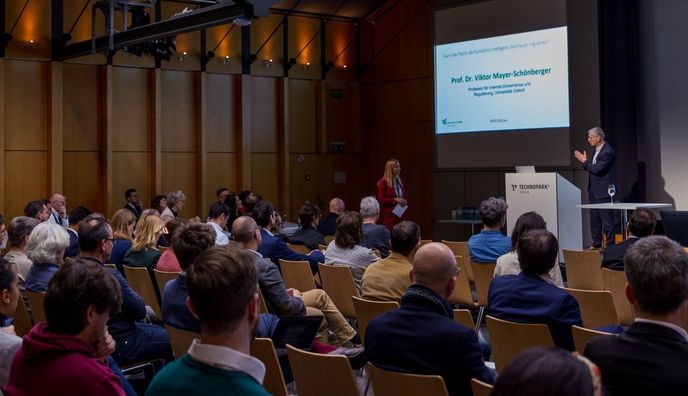
Regulating AI - easier said than done. A day between paragraphs, satellites and start-ups
Technopark Zurich normally belongs to start-ups. But on 27 March 2026, lawyers, administrative experts, researchers and digital activists took over: The Law & Tech Lab at the University of St. Gallen hosted the third AI conference. The key question: How should artificial intelligence be regulated in Switzerland - and when is the right time to do so?

Switzerland as a centre of innovation: International settlements as a driver of growth
Switzerland's innovative strength is recognised worldwide. However, the global competition for AI talent and technologies requires more than just good framework conditions - it needs targeted international networking.


The right AI entry point for every company size
How can small and medium-sized companies use artificial intelligence sensibly without high barriers to entry or unrealistic expectations? The article "The right AI entry point for every company size" shows in a practical way how AI agents can already take on specific tasks today and which entry paths are suitable depending on technical maturity.
AI is fundamentally changing logistics processes - also for SMEs
Artificial intelligence is gradually finding its way into logistics. Where manual processes used to dominate, digital systems now support employees and prepare decisions based on data. This change can be seen both in the warehouse and along complex transport chains.
How external data makes AI more reliable - Retrieval augmented generation explained
Artificial intelligence (AI) is changing the world of work - but many companies are faced with the challenge of incomplete or unreliable answers from language models. Retrieval Augmented Generation (RAG) offers a solution: the method combines AI systems with external, verifiable data sources to create comprehensible, up-to-date and fact-based results.
Making complex data easy to understand
Data often contains more knowledge than is apparent at first glance. Small and medium-sized enterprises (SMEs) in particular face the challenge of making meaningful use of unstructured information such as customer feedback or operating logs. A new method from research can help with this: so-called hyperbag graphs. They represent data as networks in which connections, patterns and weightings between different elements can be identified – for example, how often certain topics occur together.